
An image of mr zen hosted on Xyphen Fileshare :o
What is Xyphen Fileshare?
Xyphen Fileshare, in its barest of descriptions, is just a fileshare. That’s all it does, point a link to a file.
We run a public instance so anyone can use it out of the box, but you are never restricted to our servers. Xyphen Fileshare is built for self-hosting. Admins and developers can clone the repository, tweak the code to their liking, host it for their own private network, or just fork it. Hell, do whatever you want with it. There’s no personal gain or profit motive here, it was built for the people, and that’s what open source is all about.
Why? What about {insert service here}?
Well, that’s the real question here. A lot of people believe that the current service they’re using suits their needs amazingly. I’m not here for those people: I’m here for the few that don’t have their needs catered.
Xyphen Fileshare has a few features which I personally haven’t seen in many filesharing services, since they’re extremely… well, expensive to host. Or just overlooked. For starters, Xyphen Fileshare supports forever files… cheer if you want to. Essentially, they’re just files which last forever, with the only downside being that your file is there for as long as the service is up. This will hopefully be fixed with the addition of file tokens, which allows a user to delete their files upon request, but this is currently a low-priority under many other fixes and features. For now, requesting the admin to delete the file is the best course of action for that.
Another cool feature is that Xyphen Fileshare hashes uploads. No, this isn’t encryption, CryptPad exists exactly for that purpose. If you plan on hosting a private (or public) fileshare instance, hashing will be extremely useful to prevent CSAM, illicit material, or distribution of IP/unwanted content. While this may look a bit like what a surveillance state would enjoy, this is actually entirely the opposite; it’s to protect your data. Imagine a package. A hash is essentially a unique barcode generated by the file’s contents; the server scans the barcode to see if it’s on a banned list, without ever opening the package.
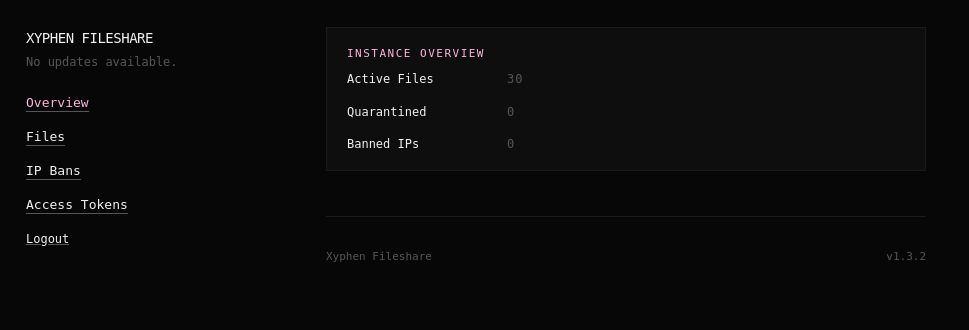
The admin dashboard homepage :p
Well, okay. That might not pique your interest. However, you can actually configure the expiry time of your files. For example, if you want a file to last only an hour, you can just set that. 72 hours is the default for most instances, however an administrator can configure the default themselves. Once your file is expired, it gets wiped instantly. No delays, nothing. Want a backup? Too bad.
So… Cool stuff. Where do I find it?
Our public instance is hosted on xyphen.org/fileshare, and our source code is here. If you want to help work on the software, message me! I’m open to any help, whether that’s through hardening, UX polishing, or just general QoL enhancements.